
The LA/Long Beach Overweight Container Corridor
Which streets around the ports allow ocean containers above the 80,000 lb legal limit, who issues the permits, and the axle and chassis rules, with a to-scale route map.
Sources last checked Nov 2, 2026.
The Corridor at a Glance
Some import containers arrive heavier than a standard truck can haul legally on California roads. Around the ports of Los Angeles and Long Beach, Caltrans and the cities of Los Angeles, Long Beach and Carson have designated an overweight container corridor: named streets and highway segments where a permitted truck may operate up to 95,000 lb gross. This guide pulls together what the official sources say for shippers planning heavy imports through LA/Long Beach.
Whisk Freight is a freight broker. We arrange container drayage with licensed motor carriers and own no trucks or chassis; the carrier holds the permits and the equipment.
Permits from each jurisdiction: CaltransLos AngelesLong BeachCarson Who issues what
Informational only, not legal or permit advice; verify with the issuing agency. Routes, conditions and contacts change.
- State highway
- Los Angeles street
- Carson street
- Long Beach street
95,000 lb gross maximum on permit, against the normal 80,000 lb
- 1Steer axle 20,000 lb
- 2Tractor drive group Tri-axle, 43,500 lb; axles at least 4 ft 0 in apart
- 3Chassis (trailer) group Tri-axle, 43,500 lb; axles at least 4 ft 0 in apart
- 4Between groups At least 22 ft 6 in
- 5Kingpin to rear axle (KPRA) 40 ft maximum (Caltrans); at least 35 ft (Long Beach)
- 6Overall length 65 ft maximum
What the Corridor Is
Normal state and federal limits cap a tractor and container chassis at 80,000 lb gross. The corridor lets a truck carrying an overweight ocean container run at up to 95,000 lb gross (43,130 kg, per the Port of Los Angeles) on designated routes only, with proper equipment and a permit from every jurisdiction it passes through.
- State highways: part of Route 1 (Pacific Coast Highway) and the Terminal Island Freeway (Routes 47 and 103), under CVC §35700.5 and a Caltrans annual permit.
- City streets: listed streets in the Los Angeles districts of Wilmington, San Pedro and Terminal Island; designated streets in Long Beach, including Port of Long Beach pier roads; and listed streets in Carson.
- Nowhere else: the Port of Los Angeles states that other cities not shown on the corridor map do not have approved overweight corridors.
Why It Exists
The Port of Los Angeles describes the corridor as created to help overweight 40 ft and larger ocean containers travel on designated city streets in and around the port. CVC §35700.5 limits the state permit to intermodal containers in international commerce. State law first allowed these permits in 1993 (AB 2438, Chapter 1037), after the City of Long Beach asked for them to support port growth and keep cargo from shifting to other ports. A 1997 law (SB 839) extended the original sunset date to January 1, 2003, and a 2002 law (SB 2072) removed the sunset date. A 2011 law (AB 1128) lengthened the Route 1 segment and added the City of Carson, so port cargo could reach warehouses in and around Carson. This history is from the Assembly Transportation Committee analysis of AB 1128 and Los Angeles Council File 02-0002-S4.
What Freight Uses It
The official sources describe the freight only as overweight ocean (intermodal) containers in international commerce. The Port of Los Angeles describes 40 ft and larger boxes in its overview but lists 20 ft equipment in its cargo weight guide. Long Beach adds that the load must be reducible and Carson limits its permit to ocean containers. No hazardous materials are allowed under CVC §35700.5 or the Long Beach permit. See the glossary entry for an overweight container.
Key Terms
- CVC §35700.5
- The California Vehicle Code section behind the state corridor permit.
- KPRA
- Kingpin to rear axle: the distance from the chassis kingpin to its last axle.
- Tri-axle group
- Three axles working as one group, on the tractor (drive) or the chassis.
- OVSP
- Long Beach's Overweight Vehicle Special Permit.
- GAWR
- The manufacturer's axle ratings.
Legal Basis
Where the Rules Come From, Level by Level
| Level | Source | What it says |
|---|---|---|
| Federal | 23 U.S.C. 127 (opens in a new tab) and 23 CFR 658.17 (opens in a new tab) | On the Interstate System and reasonable access to it: 80,000 lb gross, 20,000 lb single axle, 34,000 lb tandem and the Bridge Formula. States may issue special permits for nondivisible vehicles or loads, and some older state limits are grandfathered. The corridor is a state and city permit program for named state routes and city streets. How federal limits apply to each corridor segment is for the issuing agency to confirm. |
| State law | CVC §35700.5 (opens in a new tab) | Allows Caltrans to issue annual permits up to 95,000 lb gross for intermodal containers in international commerce, on a named part of the Terminal Island Freeway and of Route 1, with axle limits set by Caltrans. No hazardous materials. Overweight operation outside the corridors is not authorized, and violations can lead to permit revocation. Last amended by AB 1128 (2011), in effect January 1, 2012; first enacted in 1993 (see Why It Exists). |
| Caltrans | Annual Permit 113-A conditions (opens in a new tab); Sea Container Permit page (opens in a new tab) | Annual sea container permit for a 4-axle tractor and 3-axle trailer, 95,000 lb maximum, with axle, spacing, length and travel conditions. |
| Los Angeles | Public Works street list (opens in a new tab); Street Services overload permits (opens in a new tab) | City streets in Wilmington, San Pedro and Terminal Island approved for overweight containers, with city overload permits (Los Angeles Municipal Code §62.141 and following; the Heavy Container Corridor annual permit is §62.143(a)(3)). |
| Long Beach | OVSP application package 2026 (opens in a new tab) | Overweight Vehicle Special Permit under Long Beach Municipal Code Chapter 10.41 and Resolution C-25854, for reducible loads over 80,000 lb and up to 95,000 lb, on designated streets. |
| Carson | Carson Municipal Code §3262 (opens in a new tab) | Overweight container corridor streets in Carson (Ord. 12-1502), annual permits and operating rules. |
| Ports | Port of Los Angeles trucks page (opens in a new tab) | Describes the corridor and its map, and states that permits are required from each jurisdiction and that other cities not shown on the map do not have approved overweight corridors. |
| LA County | Public Works permit portal, Attachment 13 (opens in a new tab) | As of May 12, 2026, the County no longer issues these permits in the Harbor District; the City of Long Beach is responsible there. Some older materials, including the Port of Los Angeles trucks page, still list County permits; the County's May 12, 2026 notice governs. |
The Caltrans annual permit conditions give the Terminal Island Freeway segment (Routes 47 and 103) as Route 1 to Ocean Boulevard. On a permitted trip, follow the limits written on the permit itself.
Permits: Who Issues Them
A corridor trip usually crosses more than one jurisdiction, and the Port of Los Angeles notes that permits are required from each one. Caltrans covers the state highway segments; each city covers its own streets. Fees are set by each agency and are not repeated here.
Caltrans
- Covers
- Route 1 (Pacific Coast Highway), Sanford Ave. to Harbor Ave.; Terminal Island Freeway, Route 1 to Ocean Blvd.
- Permit types
- Annual sea container permit, valid one year
- Key requirements in the agency's documents
- Apply through the Caltrans Transportation Permit System; allow at least 14 business days; renewals up to 60 days before expiration; annual indicia; current CVSA decal on the hauling equipment.
City of Los Angeles (Bureau of Street Services)
- Covers
- Listed streets in Wilmington, San Pedro and Terminal Island
- Permit types
- Annual and single-trip overload permits; the municipal code also describes a 30-day permit (§62.143(a)(1))
- Key requirements in the agency's documents
- Liability insurance on file with the city (see the current annual and single-trip requirement sheets).
City of Long Beach (Public Works)
- Covers
- Designated Long Beach streets on the OVSP routes map
- Permit types
- Annual and single-trip OVSP
- Key requirements in the agency's documents
- CHP 407F inspection every 90 days; CVSA decal; insurance listing each VIN and plate; signed addendum; driver training certificate; overweight placards front and rear.
City of Carson
- Covers
- Streets listed in CMC §3262.3
- Permit types
- Annual permit, expiring December 31
- Key requirements in the agency's documents
- Ocean containers only; driver training; vehicle inspection every 90 days.
Who issues corridor permits (fees omitted; check each agency's current schedule).
Weight and Axle Limits
The permits pair a 4-axle tractor (steer axle plus a tri-axle drive group) with a tri-axle chassis. The group limits add up to more than 95,000 lb, so the 95,000 lb gross limit governs. Caltrans caps the kingpin-to-rear-axle distance at 40 ft while Long Beach requires at least 35 ft, so equipment has to fit both where a trip uses both.
| Item | Caltrans annual permit (Figure 202.39) | Long Beach OVSP |
|---|---|---|
| Gross vehicle weight | 95,000 lb maximum | Over 80,000 lb up to 95,000 lb, reducible loads |
| Steer axle | 20,000 lb | 20,000 lb |
| Tractor drive group | Tri-axle, 43,500 lb; axles at least 4 ft 0 in apart | Duals on all non-steer axles; within the manufacturer's axle ratings (GAWR) |
| Chassis (trailer) group | Tri-axle, 43,500 lb; axles at least 4 ft 0 in apart | Same as above |
| Between groups | At least 22 ft 6 in | Not stated separately |
| Kingpin to rear axle (KPRA) | 40 ft maximum | At least 35 ft |
| Overall length | 65 ft maximum | Not stated separately |
| Configuration | 4-axle tractor plus 3-axle trailer (7 axles) | Not stated separately |
Cargo Weight Guide
The Port of Los Angeles publishes estimated cargo weights for each container and equipment setup, shown below in our own row labels. The figures are for the cargo alone, not the gross weight, and cargo may not exceed the container's rated capacity. The guide lists no setup for 20 ft cargo between 37,500 and 44,000 lb; ask the carrier for that range.
| Container and equipment | Corridor permit | Estimated cargo weight |
|---|---|---|
| 20 ft on a standard chassis | Not noted | Up to 37,500 lb (17,025 kg) |
| 20 ft on a tri-axle slider chassis | Not noted | 44,001 to 46,000 lb (19,977 to 20,865 kg) |
| 20 ft on a tri-axle slider chassis behind a 4-axle tractor | Yes, on the corridor only | 44,001 to 56,000 lb (19,977 to 25,424 kg) |
| 40 ft (8 ft 6 in high) on a standard chassis | Not noted | Up to 46,500 lb (21,111 kg) |
| 40 ft (8 ft 6 in high) on a tri-axle slider chassis behind a 4-axle tractor | Yes, on the corridor only | 46,501 to 56,000 lb (21,112 to 25,424 kg) |
Chassis Background
Chassis background: 40 ft tri-axle chassis, 20 ft tri-axle slider, tri-axle combo chassis and spread-axle chassis. The Port of Los Angeles and Caltrans describe a tri-axle (slider) chassis behind a 4-axle tractor. The Long Beach permit allows any axle combination that meets its rider and CVC §§35550 and 35551. None of the permit documents names spread-axle chassis, so whether one qualifies on a given route is for the carrier and the agency to confirm.
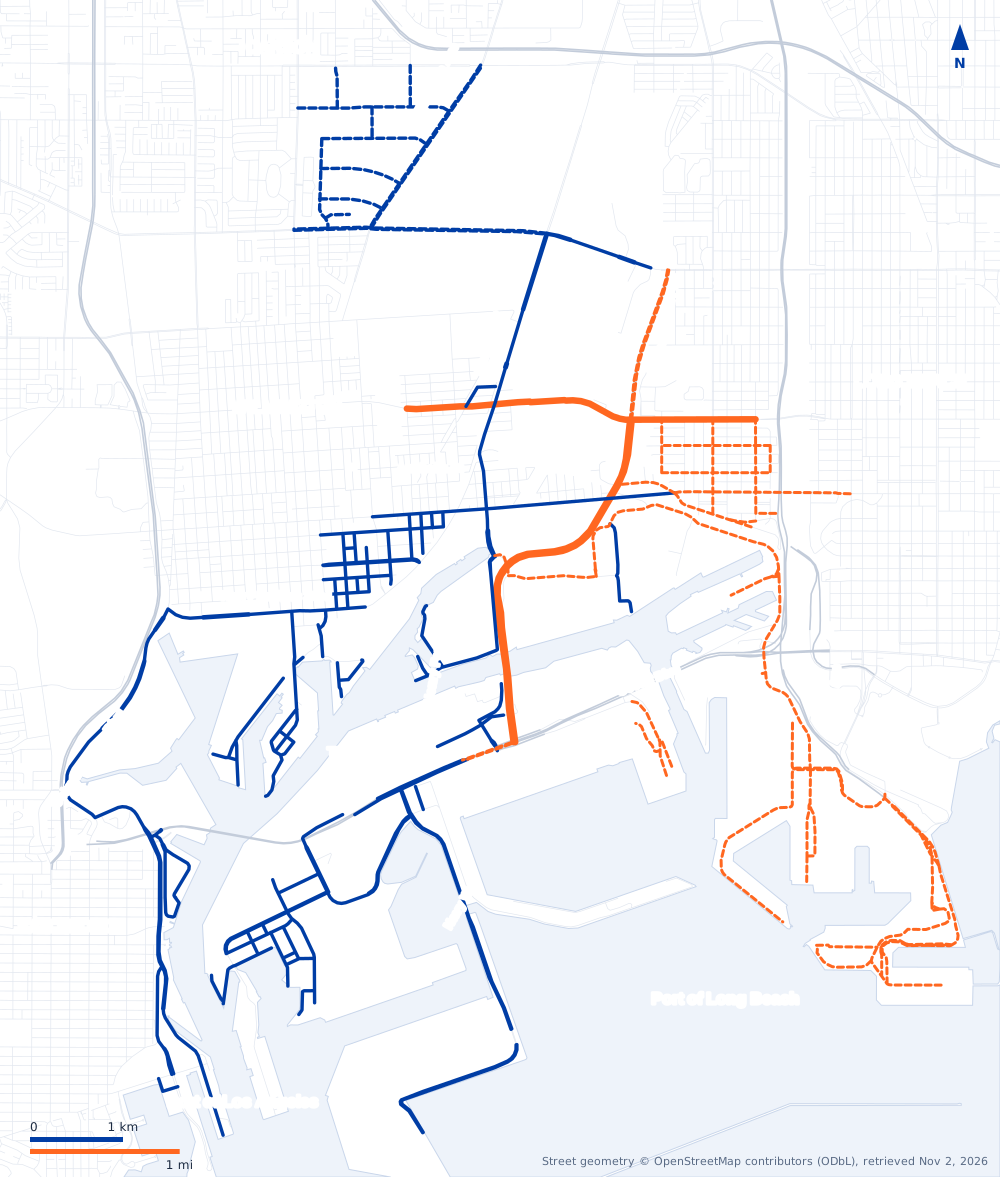
Approved Route Map
Drawn to scale from OpenStreetMap street geometry. Lines follow the written official lists for the state segments, Los Angeles and Carson. Long Beach publishes only a route map marked not to scale, so its streets are traced from that map and shown dashed. A few listed streets could not be placed reliably and are left off rather than guessed; they are marked in the street lists below.
- State highway segment (CVC 35700.5, Caltrans)
- City of Los Angeles listed street
- City of Carson listed street
- Long Beach street read from the city's permit map (no written list)
State Highway Segments
- Route 1 (Pacific Coast Highway), Sanford Ave. in Los Angeles to Harbor Ave. in Long Beach, 2.4 miles (CVC §35700.5; Caltrans).
- Terminal Island Freeway (Routes 47 and 103), Route 1 to Ocean Blvd., as written in the Caltrans permit conditions.
Approved Streets
City of Los Angeles streets: this list shows only streets that appear on both official City of Los Angeles lists, Public Works Rev. 5-03-2016 (linked by the Port of Los Angeles) and Rev. 6-18-12 (linked by the StreetsLA overload permit portal).
Wilmington
- Alameda Street
- Anaheim Street east of Eubank Ave.
- Anchorage Road
- Avalon Boulevard south of Harry Bridges Blvd.
- Banning Boulevard from G St. to E St.
- Banning Boulevard from D St. to C St.
- Broad Avenue south of Harry Bridges Blvd.
- C Street from Broad Ave. to Lecouvreur Ave.
- Canal Avenue
- Coil Avenue north of Hwy 1 (PCH)
- Colon Street from Sanford Ave. to 909 E. Colon St. (listed; not drawn on the map)
- D Street from Broad Ave. to McFarland Ave.
- E Street from Broad Ave. to Alameda St.
- Eubank Avenue between Anaheim St. and Harry Bridges Blvd. (listed; not drawn on the map)
- F Street from Quay Ave. to Banning Blvd.
- F Street from Eubank Ave. to Pioneer Ave. (listed; not drawn on the map)
- Falcon Street
- Flint Avenue from Anaheim St. to end south of F St.
- Fries Avenue south of Harry Bridges Blvd.
- G Street from alley east of Broad Ave. to Watson Ave.
- Harry Bridges Boulevard
- Henry Ford Avenue
- Hermosa Street
- La Paloma Street
- Lakme Avenue from D St. to Harry Bridges Blvd.
- Lecouvreur Avenue from end north of E St. to C St.
- McFarland Avenue from G St. to end south of F St.
- Neptune Avenue south of Harry Bridges Blvd. (listed; not drawn on the map)
- O Street from Coil Ave. to Alameda St.
- Peninsula Road
- Pier A Street
- Pier A Place
- Pioneer Avenue from Anaheim St. to G St.
- Quay Avenue from G St. to Harry Bridges Blvd.
- San Clemente Street
- Sanford Avenue from Anaheim St. to E St.
- Sanford Avenue from 130 south of Hwy 1 (PCH) to Colon St. (as printed on the 6-18-12 list, no unit given) (listed; not drawn on the map)
- Sepulveda Boulevard from Long Beach to Carson city limits
- Shore Road
- Walter Street (listed; not drawn on the map)
- Watson Avenue from Anaheim St. to G St.
- Yacht Street
San Pedro
- Adams Drive
- Admiral Higbee Way (listed; not drawn on the map)
- Ferry Street
- Front Street
- Harbor Boulevard
- John S. Gibson Boulevard
- Miner Street
- Outer Street
- Pacific Avenue from Front St. to John S. Gibson Blvd.
- Regan Street
- Signal Street
Terminal Island
- Altoona Place (listed; not drawn on the map)
- Barracuda Street
- Bass Street
- Cannery Street
- Carack Avenue
- Earle Street
- Mormon Street (listed; not drawn on the map)
- Morris Street (listed; not drawn on the map)
- Navy Way
- New Dock Street
- Ocean Avenue (listed; not drawn on the map)
- Pilchard Street
- Sardine Street
- Seaside Avenue
- Terminal Way
- Tuna Street
- Ways Street
- Wharf Street
Carson (CMC §3262.3)
- (a) Alameda Street, southerly city limit to Sepulveda Blvd.
- (b) Sepulveda Boulevard, Avalon Blvd. to Alameda St.
- (c) Wilmington Avenue, Sepulveda Blvd. to 223rd St.
- (d) Watsoncenter Road, Avalon Blvd. to Wilmington Ave.
- (e) 230th, 233rd and 236th Streets, Banning Blvd. to Wilmington Ave.
- (f) 238th Street, Banning Blvd. to cul-de-sac
- (g) Bonita Street, Watsoncenter Rd. to 223rd St.
- (h) Lucerne Street, Watsoncenter Rd. to 223rd St.
- (i) Utility Way, 230th St. to Watsoncenter Rd.
- (j) Banning Boulevard, Sepulveda Blvd. to 230th St.
Long Beach (From the City's Permit Map)
Long Beach has no written street list in its 2026 OVSP package; these streets are read from its routes map (May 2024, marked no scale) and the Port of Long Beach overweight cargo map in the same package. The city map marks a short segment as closed on Pier B Street near Pico Avenue. Separately, a Port of Long Beach project nominated to the California Transportation Commission includes permanent closure of the Ninth Street at-grade rail crossing where 9th Street meets Pico Avenue. Check the current map with the city before routing in this area.
- Terminal Island Freeway, Willow St. to Pacific Coast Hwy
- Judson Avenue, Cowles Street, 16th Street and Fashion Avenue (west of the Terminal Island Freeway)
- Santa Fe Avenue, Pacific Coast Hwy to 9th St.
- Harbor Avenue, Pacific Coast Hwy to 11th St.
- Anaheim Street, I St. to Daisy Ave.
- I Street and 9th Street
- 10th Street and 11th Street east of Harbor Ave.
- Pier A Way, Pier B Street, Pier C Street and Pico Avenue
- Pier E Street, Pier F Avenue, Pier G Avenue, Pier T Avenue
- Harbor Plaza, Harbor Scenic Drive, Pier J Avenue and Pier J Way
- Ocean Boulevard west of the Terminal Island Freeway
- Pier S Avenue and the Long Beach portion of New Dock Street (listed; not drawn on the map)
"Listed; not drawn on the map" means the street is on the official list but its limits could not be placed on public street geometry without guessing (for example, an end point given as a street address).
Driver and Carrier Rules
Each permit carries its own conditions. Examples from the documents:
- Stay on the corridor. CVC §35700.5 does not authorize overweight operation outside the designated corridors. Long Beach allows designated streets or the most direct route to them, and Long Beach and Carson bar residential streets.
- Speed and spacing. Long Beach and Carson set a 30 mph maximum; Long Beach requires 100 ft between permit trucks on bridges. Caltrans requires the far right lane, no convoys and stops at open scales.
- Weather and visibility. Caltrans bars travel when visibility is under 1,000 ft; Long Beach bars travel in inclement weather.
- Markings and paperwork. Caltrans annual indicia and a current CVSA decal; Long Beach yellow OVERWEIGHT VEHICLE placards front and rear; the full permit package carried in the truck.
- Inspection and training. Long Beach requires a CHP 407F inspection every 90 days and a driver training certificate; Carson requires training and inspection every 90 days.
- No hazardous materials under CVC §35700.5 or the Long Beach permit.
- Damage and accidents. Caltrans conditions require reports of damage to state facilities and of reportable accidents.
How Whisk Freight Arranges Overweight Containers
When you tell us a container's gross weight up front, we arrange container drayage with a carrier that can confirm the permits and the tractor and chassis setup for the route, or we discuss options such as transloading near the port. A heavy container can be hauled on permit to a warehouse inside the corridor, where enough cargo is unloaded or transloaded to bring each load to legal weight before it continues inland; CVC §35700.5(d) does not authorize overweight operation outside the designated corridors. See transload vs direct drayage.
Frequently Asked Questions
What is the LA/Long Beach overweight container corridor?
A set of state highway segments and city streets around the ports of Los Angeles and Long Beach where a permitted truck hauling a heavy ocean container may operate above the normal 80,000 lb gross limit, up to 95,000 lb, with equipment that meets the permit conditions.
Who issues overweight corridor permits?
Each jurisdiction on the route issues its own: Caltrans for the state highway segments, the City of Los Angeles for its streets, the City of Long Beach for its streets and the City of Carson for its streets. The Port of Los Angeles notes that permits are required from each jurisdiction. Los Angeles County stated in May 2026 that it no longer issues these permits in the Harbor District.
What is the maximum weight in the corridor?
95,000 lb gross vehicle weight under CVC 35700.5 and the city programs, with axle group limits set by each permit. Caltrans permit conditions list 20,000 lb on the steer axle and 43,500 lb on each tri-axle group, on a 4-axle tractor and 3-axle chassis.
What chassis does a corridor load need?
The Caltrans annual permit is written for a 7-axle combination: a 4-axle tractor and a 3-axle trailer, which in practice means a tri-axle container chassis. For 20 ft containers, the Port of Los Angeles cargo weight guide lists a tri-axle slider chassis. Spacing, kingpin and length limits apply. Whether a given chassis meets every agency's conditions is for the motor carrier and the issuing agency to confirm.
Can an overweight container leave the corridor?
Not at corridor weights. CVC 35700.5 states that the section does not authorize overweight operation outside the designated corridors, and Long Beach and Carson restrict permit trucks to designated streets. A load bound beyond the corridor has to be legal weight for the rest of the trip or travel under a separate permit where one is available.
Is there an official list of approved streets?
Yes for the state highway segments (CVC 35700.5 and Caltrans permit conditions), the City of Los Angeles (a Public Works street list) and Carson (Carson Municipal Code 3262.3). Long Beach publishes a route map rather than a written list, so the Long Beach lines on our map are traced from that map and should be confirmed with the city.
Can Whisk Freight arrange an overweight container?
Whisk Freight is a freight broker. We arrange container drayage with licensed motor carriers and own no trucks or chassis. When a container is over legal weight, we ask the carrier to confirm its permits and equipment for the route before we confirm the load with you.
Sources
Informational only, not legal or permit advice; verify with the issuing agency. Trade press and industry pages are treated as leads, not proof.
- California Vehicle Code §35700.5 (AB 1128, Stats. 2011 ch. 298), California Legislative Information. leginfo.legislature.ca.gov (opens in a new tab) Checked Nov 2, 2026.
- Assembly Committee on Transportation, analysis of AB 1128 (Furutani), hearing of May 2, 2011 (history of AB 2438, Ch. 1037, Stats. 1993; SB 839, Ch. 358, Stats. 1997; SB 2072, Ch. 229, Stats. 2002). www.leginfo.ca.gov (opens in a new tab) Checked Nov 2, 2026.
- City of Los Angeles, Council File 02-0002-S4, Overweight Truck Corridor (2002 support for removing the January 1, 2003 sunset date of CVC §35700.5). lms.lacity.gov (opens in a new tab) Checked Nov 2, 2026.
- Caltrans, Sea Container Permit page. dot.ca.gov (opens in a new tab) Checked Nov 2, 2026.
- Caltrans, Annual Permit 113-A Ocean Container Permit Conditions, revised September 19, 2017 (Figure 202.39). dot.ca.gov (opens in a new tab) Checked Nov 2, 2026.
- Caltrans, Transportation Permits Manual, Chapter 2, §202.2 Intermodal Cargo Container Annual Permit (2022). dot.ca.gov (opens in a new tab) Checked Nov 2, 2026.
- Caltrans, Container Weight Exemption page. dot.ca.gov (opens in a new tab) Checked Nov 2, 2026.
- Port of Los Angeles, Trucks page, Overweight Container Corridor section and Cargo Weight Guidelines. portoflosangeles.org (opens in a new tab) Checked Nov 2, 2026.
- City of Los Angeles Public Works, Overweight Container Corridor street list, Rev. 5-03-2016 (linked from POLA). kentico.portoflosangeles.org (opens in a new tab) Checked Nov 2, 2026.
- Port of Los Angeles, Overweight Container Corridor map (October 2019). kentico.portoflosangeles.org (opens in a new tab) Checked Nov 2, 2026.
- City of Los Angeles, Bureau of Street Services overload permits portal (annual and single-trip requirements; Revised Overweight Container Corridor 6-18-12). bsspermits.lacity.org (opens in a new tab) Checked Nov 2, 2026.
- City of Los Angeles StreetsLA, Revised Overweight Container Corridor list, Rev. 6-18-12 (linked from the overload portal's Permit Rules and Regulations page). permits.streets.lacity.gov (opens in a new tab) Checked Nov 2, 2026.
- Los Angeles Municipal Code §§62.141 to 62.149, Overloads (American Legal Publishing). codelibrary.amlegal.com (opens in a new tab) Checked Nov 2, 2026.
- City of Long Beach Public Works, Permits and Guidelines. www.longbeach.gov (opens in a new tab) Checked Nov 2, 2026.
- City of Long Beach, Overweight Vehicle Special Permit application package 2026 (OVSP routes map May 2024; Port of Long Beach overweight cargo map September 2023). www.longbeach.gov (opens in a new tab) Checked Nov 2, 2026.
- California Transportation Commission, TCEP nomination: Port of Long Beach Pier B Early Rail Enhancements, East Expansion (includes permanent closure of the Ninth Street at-grade crossing). catc.ca.gov (opens in a new tab) Checked Nov 2, 2026.
- City of Carson Municipal Code §3262 (Ord. 12-1502), Overweight Container Corridor. ecode360.com (opens in a new tab) Checked Nov 2, 2026.
- Los Angeles County Public Works, Transportation Permit Application Portal and Attachment 13 (May 12, 2026). pw.lacounty.gov (opens in a new tab) Checked Nov 2, 2026.
- 23 CFR 658.17, Weight (eCFR). www.ecfr.gov (opens in a new tab) Checked Nov 2, 2026.
- 23 U.S.C. 127, Vehicle Weight Limitations: Interstate System (Cornell LII). www.law.cornell.edu (opens in a new tab) Checked Nov 2, 2026.
- OpenStreetMap contributors, street geometry for the map (ODbL), retrieved Nov 2, 2026. www.openstreetmap.org (opens in a new tab) Checked Nov 2, 2026.