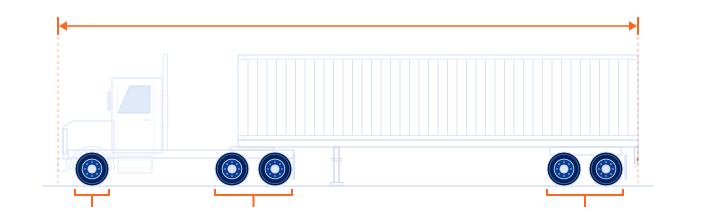
Container Weight Limits: Axles, Chassis and Sliding
What the steer, drive and chassis axles may carry on California roads, which chassis a 20, 40, 45 or 53 ft container rides on, and how sliding the axles keeps a load from going overweight.
Quick Answer
How Much Weight Can a Drayage Truck Haul?
Every axle group and the whole truck must be within limits, cargo included.
Shorter axle spacing can lower the allowable gross (bridge formula).
Sliding the axles moves weight between groups. It does not reduce the total.
80,000 lb Gross Maximum
Steer Axle12,500 lb*
Tractor Drive Tandem34,000 lb
Standard Chassis Tandem34,000 lb
* Planning figure, not a legal limit. Verify axle and tire ratings. Legal limit: 20,000 lb per axle (CVC 35550), or the axle or tire rating if lower.
— The Limits
Max Weight by Axle Group
A container rig rests on three axle groups. Each group has its own limit and the whole truck has a gross limit. A load is legal only when all four are within limits.
Steer12,500*
Drive34,000
Chassis Tandem34,000
The three axle groups on a 40 ft container rig. Every group has its own limit, and the whole truck has a gross limit.
Steer Axle
12,500 lb*
The single axle under the cab. 12,500 lb is a typical planning figure, not a legal limit. The legal limit is 20,000 lb per axle, or the axle or tire rating if lower.
*A typical planning figure, not a legal limit. The legal limit is 20,000 lb per axle (CVC 35550), or the axle or tire rating if lower.
Chassis axle groups under the CVC 35551 table. Distances are measured between the first and last axle of the group and rounded to the nearest whole foot.
Chassis Axles
Distance, First to Last
Rounded
Max Weight
Standard tandem
49 in
Under 8 ft 6 in
34,000 lb
2-axle spread
109 in (9 ft 1 in)
9 ft
39,000 lb
2 axles, 10 ft or more
120 in or more
10 ft or more
40,000 lb
Tri-axle
8 ft 6 in to 9 ft 5 in
9 ft
42,500 lb
Tri-axle, wider
10 ft / 11 ft
10 ft / 11 ft
43,500 / 44,000 lb
Axle groups do not add up to the gross. A rig can have more axle capacity than 80,000 lb, but the gross still caps the truck. The limits in the table include all enforcement tolerances (CVC 35551(e)).
Gross Weight by Axle Spacing
The gross allowed for the whole rig depends on the distance from the steer axle to the last axle, and on the number of axles. A standard rig has 5 axles; a rig with a tri-axle chassis has 6.
Selected rows from the CVC 35551 weight chart as published by Caltrans. The full chart runs from 4 ft to 60 ft.
Short boxes are often heavy, and most of their weight lands on the chassis axles. The chassis axle setup decides how much a 20 ft container can weigh.
20 ft Container on a Standard Slider Chassis
A standard 20 ft slider chassis carries one 20 ft container on a tandem with its axles 49 in apart, so the chassis axles count as one tandem group with a 34,000 lb limit.
Steer12,500*
Drive34,000
Rear Tandem34,000
Side view; every drawing on this page shares one scale. Axle limits in pounds. *Steer 12,500 lb is a typical planning figure, not a legal limit; the legal limit is 20,000 lb per axle (CVC 35550), or the axle or tire rating if lower. Tractor and chassis dimensions from manufacturer specs; details simplified.
Best For
Standard 20 ft dry containers
Loads where neither tandem goes over 34,000 lb
Axle Limits
Steer: 12,500 lb* (planning figure; legal limit 20,000 lb per axle, or the axle or tire rating if lower)
Drive tandem: 34,000 lb
Chassis tandem: 34,000 lb (axles less than 8 ft 6 in apart)
Gross: set by the distance from the steer axle to the last axle, never above 80,000 lb
Chassis Specs
23 ft 6 in retracted, 27 ft 6 in extended; spring-loaded pins lock the slider in either position (DCLI fleet)
Carries: One 20 ft containerRear group: Tandem, 49 inRear max: 34,000 lb
20 ft Container on a 2-Axle Spread Chassis
A spread-axle chassis sets its two axles about 109 in apart. California rounds that to 9 ft, and two axles 9 ft apart may carry 39,000 lb instead of 34,000 lb.
Steer12,500*
Drive34,000
Rear Spread39,000
Side view; every drawing on this page shares one scale. Axle limits in pounds. *Steer 12,500 lb is a typical planning figure, not a legal limit; the legal limit is 20,000 lb per axle (CVC 35550), or the axle or tire rating if lower. Tractor and chassis dimensions from manufacturer specs; details simplified.
Best For
Heavy 20 ft loads that are over a standard tandem
Loads where axle spacing, not the gross, is the limit
Axle Limits
Steer: 12,500 lb* (planning figure; legal limit 20,000 lb per axle, or the axle or tire rating if lower)
Drive tandem: 34,000 lb
Chassis axles, 109 in apart: 39,000 lb (9 ft in the CVC 35551 table)
At 10 ft or more apart, two axles reach 40,000 lb, the same as 20,000 lb per axle
Gross: set by the distance from the steer axle to the last axle, never above 80,000 lb
Carries: One heavy 20 ft containerRear group: Two axles, 109 inRear max: 39,000 lb
20 ft Container on a Tri-Axle Slider Chassis
A 20 ft tri-axle slider puts three axles under one heavy 20 ft container. Three axles set 9 ft apart, first to last, may carry 42,500 lb, the most of any common 20 ft setup.
Steer12,500*
Drive34,000
Rear Tri-Axle42,500
Side view; every drawing on this page shares one scale. Axle limits in pounds. *Steer 12,500 lb is a typical planning figure, not a legal limit; the legal limit is 20,000 lb per axle (CVC 35550), or the axle or tire rating if lower. Tractor and chassis dimensions from manufacturer specs; details simplified.
Best For
Heavy 20 ft loads such as stone, metals, paper or bagged goods
Loads over a standard tandem or a spread axle
Axle Limits
Steer: 12,500 lb* (planning figure; legal limit 20,000 lb per axle, or the axle or tire rating if lower)
Drive tandem: 34,000 lb
Chassis tri-axle, 9 ft first to last: 42,500 lb
Wider settings allow more: 43,500 lb at 10 ft and 44,000 lb at 11 ft
Gross: set by the distance from the steer axle to the last axle, never above 80,000 lb
Chassis Specs
33 ft closed, 41 ft extended; “the frame of this chassis slides to disperse the weight” (DCLI fleet)
GVWR up to 65,000 lb as a chassis rating, not a legal limit (DCLI fleet)
Carries: One heavy 20 ft containerRear group: Three axles, sliding frameRear max: 42,500 lb at 9 ft
— By Container Size
40 ft Containers
A 40 ft container spreads its weight between the drive tandem and the chassis tandem. On a standard gooseneck, the gross is usually the limit before either axle group.
40 ft Container on a Gooseneck Chassis
A 40 ft gooseneck chassis carries one 40 ft or 40 ft high cube on a 49 in tandem. With 34,000 lb on the drives and 34,000 lb on the chassis, the gross, not an axle group, is usually the limit.
Steer12,500*
Drive34,000
Rear Tandem34,000
Side view; every drawing on this page shares one scale. Axle limits in pounds. *Steer 12,500 lb is a typical planning figure, not a legal limit; the legal limit is 20,000 lb per axle (CVC 35550), or the axle or tire rating if lower. Tractor and chassis dimensions from manufacturer specs; details simplified.
Best For
40 ft standard and 40 ft high cube containers
Most import and export loads in 40 ft boxes
Axle Limits
Steer: 12,500 lb* (planning figure; legal limit 20,000 lb per axle, or the axle or tire rating if lower)
Drive tandem: 34,000 lb
Chassis tandem: 34,000 lb
Gross: a 5-axle rig needs 51 ft from the steer axle to the last axle for the full 80,000 lb
Two tandems 36 ft or more apart may carry 34,000 lb each, 68,000 lb together (CVC 35551(b))
Chassis Specs
Overall length 40 ft 8 in; kingpin 30 in from the front bolster; tare 6,700 lb (DCLI fleet)
Carries: One 40 ft or 40 ft high cubeRear group: Tandem, 49 inRear max: 34,000 lb
40 ft Container on a Tri-Axle Chassis
A 40 ft tri-axle chassis adds a third axle under the 40 ft gooseneck. A 6-axle rig reaches 80,000 lb gross at a shorter distance than a 5-axle rig, and the chassis axles carry more.
Steer12,500*
Drive34,000
Rear Tri-Axle42,500
Side view; every drawing on this page shares one scale. Axle limits in pounds. *Steer 12,500 lb is a typical planning figure, not a legal limit; the legal limit is 20,000 lb per axle (CVC 35550), or the axle or tire rating if lower. Tractor and chassis dimensions from manufacturer specs; details simplified.
Best For
Heavy 40 ft loads
Loads where weight on a tandem axle group is the limit, not the gross
Axle Limits
Steer: 12,500 lb* (planning figure; legal limit 20,000 lb per axle, or the axle or tire rating if lower)
Drive tandem: 34,000 lb
Chassis tri-axle at a 109 in setting: 42,500 lb (9 ft in the table)
Gross: a 6-axle rig reaches 80,000 lb at 45 ft from the steer axle to the last axle
Chassis Specs
DCLI: 40 ft 6 in; a 109 in tri-axle setting for West Coast customers; offered by reservation (DCLI fleet)
Carries: One heavy 40 ft containerRear group: Three axles, 109 inRear max: 42,500 lb
— By Container Size
45 ft and 53 ft Containers
Longer boxes ride on tandem chassis with the same axle limits as a 40 ft gooseneck. On a 53 ft chassis the tandem position is also set by the kingpin to rear axle limit.
45 ft Container on a Gooseneck Chassis
A 45 ft gooseneck chassis carries one 45 ft high cube on a standard tandem, so it has the same axle limits as a 40 ft gooseneck: 34,000 lb on the drives and 34,000 lb on the chassis.
Steer12,500*
Drive34,000
Rear Tandem34,000
Side view; every drawing on this page shares one scale. Axle limits in pounds. *Steer 12,500 lb is a typical planning figure, not a legal limit; the legal limit is 20,000 lb per axle (CVC 35550), or the axle or tire rating if lower. Tractor and chassis dimensions from manufacturer specs; details simplified.
Best For
45 ft high cube containers
Axle Limits
Steer: 12,500 lb* (planning figure; legal limit 20,000 lb per axle, or the axle or tire rating if lower)
Drive tandem: 34,000 lb
Chassis tandem: 34,000 lb
Gross: set by the distance from the steer axle to the last axle, never above 80,000 lb
Chassis Specs
DCLI fleet: 45 ft 6 in; kingpin 30 in; tandem 54 in from the rear bolster; tare 7,000 lb
Carries: One 45 ft containerRear group: Tandem, 49 inRear max: 34,000 lb
53 ft Container on a Domestic Chassis
A 53 ft chassis carries a domestic 53 ft container on a sliding tandem. The tandem is set so the distance from the kingpin to the rear axle stays within California’s 40 ft limit, and the axle limits match a standard tandem.
Steer12,500*
Drive34,000
Rear Tandem34,000
Side view; every drawing on this page shares one scale. Axle limits in pounds. *Steer 12,500 lb is a typical planning figure, not a legal limit; the legal limit is 20,000 lb per axle (CVC 35550), or the axle or tire rating if lower. Tractor and chassis dimensions from manufacturer specs; details simplified. Tandem drawn 39 ft behind the kingpin.
Best For
Domestic 53 ft rail containers
Rail ramp pickups and deliveries
Axle Limits
Steer: 12,500 lb* (planning figure; legal limit 20,000 lb per axle, or the axle or tire rating if lower)
Drive tandem: 34,000 lb
Chassis tandem: 34,000 lb
Kingpin to rearmost axle: no more than 40 ft for a semitrailer with two or more axles
Gross: set by the distance from the steer axle to the last axle, never above 80,000 lb
Chassis Specs
DCLI fleet: 53 ft 7 in; kingpin 36 in from the front bolster; tare 7,450 lb; the tandem slides so the kingpin to rear axle distance can be under 40 ft
Carries: One 53 ft domestic containerRear group: Sliding tandemRear max: 34,000 lb
— Planning Weights
Cargo Weight Guidelines for Container Drayage
The planning figures our team uses when shippers ask how much cargo a container can carry on each chassis.
Container
Chassis Type
Estimated Cargo Weight (Approximate)
20 ft
Standard steamship chassis
0 – 37,500 lb
20 ft
2-axle spread slider chassis
0 – 42,000 lb
20 ft
Tri-axle slider chassis
0 – 44,000 lb
40 ft
Standard steamship chassis
0 – 46,500 lb
California Vehicle Code Section 35551 limits the total weight any group of two or more consecutive axles may place on the highway, based on the number of axles in the group and the distance between its first and last axles. The table below summarizes typical axle weights for container drayage. Cargo guidelines apply to standard dry containers and do not apply to containers with reefer units. Maximum gross weight without a permit is 80,000 lb. A five-axle tractor and chassis needs at least 51 ft between its first and last axles to reach it. At shorter distances the limit is lower, for example 77,500 lb at 47 ft and 66,000 lb at 36 ft. A six-axle combination reaches 80,000 lb at 45 ft.Source: CVC 35551, Caltrans, Weight Limitation
Steer Axle*
Drive Axle
Rear Axle
Chassis Type
Tractor Type
12,500 lb
34,000 lb
34,000 lb
Standard
3-axle
12,500 lb
34,000 lb
39,000 lb
2-axle spread
3-axle
12,500 lb
34,000 lb
42,500 lb
Tri-axle
3-axle
*A typical planning figure, not a legal limit. The legal limit is 20,000 lb per axle (CVC 35550), or the axle or tire rating if lower. The 39,000 and 42,500 lb rear figures require about 9 ft between the first and last rear axles. Larger groups of axles, and the truck as a whole, must also stay within their own limits, so the figures in a row cannot always all be reached at once.
Typical Axle Weights on Standard 20 ft and 40 ft Containers
Maximum allowable gross weight depends on the number and spacing of the axles, not on overall truck length. Every axle group must also be within its own limit.
Standard 20 ft Container on a Steamship Line Chassis(Gross weight depends on axle spacing and may be well below 80,000 lb, for example 66,000 lb at 36 ft. Approx. cargo weight 37,500 lb.)
Steer12,500 lb*
Drive34,000 lb
Rear34,000 lb
Standard 40 ft Container on a Steamship Line Chassis(Gross weight up to 80,000 lb with 51 ft or more between the first and last axles. Approx. cargo weight 46,500 lb.)
Steer12,500 lb*
Drive34,000 lb
Rear34,000 lb
Typical Axle Weights on Slider Chassis, Slider Extended
Maximum allowable gross weight depends on the number and spacing of the axles, not on overall truck length. Every axle group must also be within its own limit.
20 ft Container on a 2-Axle Slider Chassis(Gross weight up to 80,000 lb with 51 ft or more between the first and last axles. Approx. cargo weight over 37,500 to 42,000 lb.)
Steer12,500 lb*
Drive34,000 lb
Rear39,000 lb
20 ft Container on a 3-Axle Slider Chassis(Gross weight up to 80,000 lb with 45 ft or more between the first and last axles. Approx. cargo weight over 37,500 to 44,000 lb.)
Steer12,500 lb*
Drive34,000 lb
Rear42,500 lb
Additional Notes
Axle distances are measured to the nearest whole foot. A fraction of exactly 6 in rounds up. Source: CVC 35551(c)
The limits include all enforcement tolerances. There is no additional allowance. Source: CVC 35551(e)
On Interstate highways, federal limits also apply. The California figures in this guide are the same as or lower than the federal limits. Source: 23 CFR 658.17
Cargo should be evenly distributed and secured in the container. Uneven loading can overload one axle group even when the gross weight is within the limit.
The maximum gross weight marked on the container and the rating of the chassis may limit cargo weight further.
For export containers, the shipper must provide a verified gross mass to the ocean carrier and terminal (SOLAS regulation VI/2). See the VGM calculator.
Near the Ports of LA/Long Beach, special permits may allow more than 80,000 lb on designated routes. The weights in this guide assume no overweight permit. See the LA/Long Beach overweight container corridor. Source: CVC 35700.5
Disclaimer. This guide is for general information only and is an estimate. It is not legal, engineering or compliance advice. Actual allowable weights depend on the equipment, axle configuration and spacing, permits and the laws in effect at the time. Whisk Freight Brokerage arranges transportation through licensed motor carriers, and the shipper is responsible for verifying weights and legal compliance before a container moves. Drawings are illustrative side views.
— Sliding the Axles
How Sliding the Axles Avoids Overweight
A slider chassis and a sliding fifth wheel let the driver move weight from one axle group to another. Neither one changes the total weight of the truck.
Gross Overweight
The whole truck is over its limit: 80,000 lb at most, and less on a shorter rig. Sliding cannot fix it. The load has to be lightened or moved under a permit.
Axle Overweight
The gross is legal, but one axle group carries too much, for example more than 34,000 lb on the drive tandem. This is the overweight that sliding the axles and balancing the cargo prevent.
Extend the slider chassis. On a slider chassis the axle set, called the bogie, slides along the frame and locks into holes in the rails, in 4 in or 6 in steps. Sliding it back toward the rear lengthens the axle spacing and moves weight from the tractor’s drive axles onto the chassis axles. That is the extended position shown in the slider drawings above. Source: Hyundai Translead, chassis operator’s manual
Mind the length limits. The kingpin to rearmost axle distance may not exceed 40 ft on a semitrailer with two or more axles, and a shorter rig is allowed less gross. Source: Caltrans, Vehicle Lengths, Caltrans, Weight Limitation
Weigh the rig. The driver sets the bogie and fifth wheel, then weighs the truck. The scale ticket decides, and no axle should be loaded past its rating. Source: Freightliner, Fifth Wheel Slide Operation
— Side by Side
Axle Limits by Chassis Compared
Every setup on this page on one table, with the limit on each axle group.
Legal limits on California roads, in pounds. Chassis weight ratings are manufacturer ratings, not legal limits.
*A typical planning figure, not a legal limit. The legal limit is 20,000 lb per axle (CVC 35550), or the axle or tire rating if lower. Chassis axle and gross figures are legal limits under the CVC 35551 table.
Tare counts. The tractor, the chassis, the empty container and the fuel are all part of the gross. A heavier chassis, such as a tri-axle, leaves less of the 80,000 lb for cargo even as it raises the chassis axle limit.
— For Shippers
How to Avoid an Overweight Container
The carrier picks the chassis and the driver sets the axles, but both depend on the weight the shipper sends.
Send the actual cargo weight. Send the weight of the cargo and the empty container, not an estimate. A shipper tendering a loaded container with more than 29,000 lb of cargo must give the first carrier a certification of the actual gross cargo weight. Source: 49 U.S.C. 5902
Flag a heavy 20 ft container early. A heavy 20 may need a spread-axle or tri-axle chassis, and some are offered by reservation. Telling us early gives the carrier time to arrange one. See Container Chassis Types.
Load evenly and say if it is not. Weight packed at one end loads one axle group more than the other. If the load is uneven, tell us, so the driver can set the slider or the carrier can choose a different chassis.
Count the reefer. A refrigeration unit, and a genset chassis if the box needs power on the road, add weight that leaves less room for cargo.
The tractor’s drive tandem may carry 34,000 lb. California sets 34,000 lb for a two-axle group less than 8 ft 6 in apart (CVC 35551), and the federal tandem limit is also 34,000 lb (23 CFR 658.17).
What Is the Steer Axle Limit for a Container Tractor?
For planning, this guide uses 12,500 lb* on the steer axle. That is a typical planning figure, not a legal limit. The legal limit is 20,000 lb per axle (CVC 35550), or the axle or tire rating if lower. The tractor’s own axle ratings are on its federal safety standard label. The carrier’s scale ticket shows what the steer axle actually carries.
What Is the Difference Between an Axle Overweight and a Gross Overweight?
A gross overweight means the whole truck is over its total limit, which is 80,000 lb at most and less when the axles are closer together. An axle overweight means one axle group, such as the drive tandem, is over its own limit even though the gross is legal. Sliding the axles can fix an axle overweight; it cannot fix a gross overweight.
Can Sliding the Axles Make Any Heavy Load Legal?
No. Sliding moves weight between axle groups. It does not change the total. If the gross is over the limit, the load has to be lightened or moved under a permit.
Why Does a Heavy 20 ft Container Need a Tri-Axle Chassis?
A 20 ft container puts its weight over a short span, so much of it lands on the chassis axles. A standard tandem is limited to 34,000 lb. A spread axle 109 in apart allows 39,000 lb, and a tri-axle set 9 ft first to last allows 42,500 lb.
Do Refrigerated Containers Have Different Limits?
The axle and gross limits are the same. A reefer’s refrigeration unit, and a genset chassis if one is used, add weight to the truck, which leaves less of the limit for cargo.
What If the Container Is Heavier Than the Legal Limit?
For loads staying near the ports, a permit on the LA/Long Beach overweight container corridor may allow more on approved streets. We confirm the equipment and route with the carrier before the container is picked up.
— Sources
Sources
Legal limits are from the California Vehicle Code, Caltrans and federal regulations. Chassis specs are equipment provider fleet specs and manufacturer manuals; check the current spec with the carrier.
Written by Ray Wisniewski Jr., Founder and President, Whisk Freight Brokerage. Last reviewed November 2026.
Three Generations in Freight
Send the Container Weight. We'll Price the Shipment.
Send the container size, cargo weight, port and destination, and we will arrange a carrier with the right chassis and confirm the allowable weight before loading.